


1. Preamble
This discussion paper was prepared as part of the BfN-funded project "Nature Positive Business Practices – Recommendations for Policy-making and the Market". It analyses the concept of Nature Positive Business Practices and discusses whether and under which conditions these business practices would even be possible. Also included in the analysis are the previous application of the concept and the individual levels of the concept of nature and impact measurement. The paper also makes recommendations as to where there is potential for continued development of the concept.
The concept of Nature Positive is already widely used at international level and is being incorporated into national and international strategies and objectives. It is intended to serve as a global goal for nature – parallel to the 1.5° degree target for the climate – and is already being used and promoted by well-known actors. However, the multidimensionality of the concept of nature and the associated complexity of measurement present major challenges for concrete implementation of the concept. What is more, different and largely vague definitions are used that do not provide a uniform and specific guideline for its transparent implementation.
Recommendations for ongoing development and application of the concept of Nature Positive were developed as part of the project. This took place in cooperation with experts from politics, business, science and civil society and on the basis of a comprehensive literature review – especially within the German context. This discussion paper seeks to present these recommendations in a comprehensible manner and to contribute to a future-oriented utilisation of the concept.
Abstract
The concept of Nature Positive should be designed and used as a visionary model for business, to which individual sectors can make a contribution in the form of sector visions and goals. The concept should therefore not be used at the level of individual actors as a label for the actors themselves, a supply chain or an individual product.
When addressing Nature Positive, the concept of nature should be broken down into individual key elements such as climate, biodiversity, water and air, etc., which would then permit separate analysis and measurement. There must be no compensation of negative impacts between the individual dimensions and nature must be viewed holistically in the context of a landscape approach.
The impact should be measured in relation to relevant dimensions of nature and on a location-specific basis.
The basis for reducing impacts on nature should always be the mitigation hierarchy, which stipulates that negative impacts should first be completely avoided where possible, then reduced and only restored in the next step. Measures in this regard should always focus on an actor’s core business.
1.1 Introduction to the debate
The climate debate has significantly impacted international discourse in recent years. There is an urgent need for action due to the devastating consequences of climate change – which are already noticeable today and are increasing dramatically (Intergovernmental Panel on Climate Change (IPCC), 2023). Nevertheless, political and economic measures to mitigate climate change are still being pursued at an overly sluggish pace and often only sporadically. At the same time, the discourse has broadened increasingly in recent years: awareness of the parallel nature of global crises is growing. Aside from the climate crisis, the loss of biodiversity in particular is already exhibiting a serious impact on people and nature. Climate change is closely linked to the loss of biodiversity, water availability, food production and health. This connection emerges, among other things, from a recently published report by the World Biodiversity Council (IPBES) (McElwee et al., 2024). It is reflected not least in the Kunming-Montreal Biodiversity Framework, which was adopted in 2022 and politically enshrines the restoration of nature as an international objective (CBD, 2022a).
Moreover, the private sector is also becoming increasingly aware that focussing exclusively on climate issues is not enough. For example, a 2020 report by the World Economic Forum shows that more than half of global GDP, that is, around US$ 44 trillion, is “moderately” or “heavily” dependent on nature (WEF, 2020a). Companies in sensitive sectors such as agriculture and forestry in particular are already feeling the consequences of ecosystem destruction – from declining crop yields to disruptions in the supply chain.Protecting nature is increasingly becoming a strategic imperative (Savage, 2024).
The Global Risk Report 2025 reflects this realisation as well: the risk of biodiversity loss and ecosystem collapse was ranked second among long-term global risks, whereas it still languished in 37th place in 2009, for example (WEF, 2025c). In the course of this development, there have been calls for a global target for nature conservation for years now – similar to the 1.5° degree target for climate protection. The concept of "Nature Positive" became increasingly important in this context, driven by various actors and initiatives. This concept attempts to close a gap in the debate and provide orientation. Nevertheless, this is associated with significant risks such as greenwashing, depending on how the concept is interpreted, implemented and, above all, used.
While the international debate on this topic is already well advanced and the concept of Nature Positive has become firmly established in this setting, its discussion and use in German-speaking countries remains very limited. The BfN-funded project "Nature Positive Business Practices – Recommendations for Policy-making and the Market” seeks to stimulate a debate on the concept of Nature Positive Business Practices and encourage a joint, cross-sectoral approach. The discussion paper aims to produce a comprehensive analysis of the concept of Nature Positive Business Practices, highlight opportunities and risks and develop an initial framework for its safe and future-oriented use.
1.2 Methodology
This discussion paper is based on a thorough literature review and dialogue with various experts on the topic. The literature research included analysis of almost 30 sustainability terms, including their definition, use and differentiation from the concept of Nature Positive Business Practices. Moreover, eight focus interviews were conducted with experts from academia, the private sector and civil society in order to pick up on various perspectives on the topic and then analyse them in greater depth. This was followed by a one-day, cross-sectoral face-to-face workshop in which the concept was critically discussed and scrutinised and initial key elements for a suitable delimitation were identified.
1.3 Background
Terms that describe sustainability as a whole or elements thereof play a central role in the sustainable transformation of the economy and society, but one that also demands critical appraisal. On the one hand, they can provide guidance to private sector actors and consumers and, when used correctly, create transparency. But if they are inadequately defined, verified and monitored, they also harbour a high risk of greenwashing and superficial sustainability assurances without any actual effective change. Companies and consumers are currently confronted with what seems like an almost endless number of sustainability terms and concepts that build on different approaches and in some cases on different standards and verification systems.
Some of them, sustainability included, have a clear definition, but one that is applied differently in individual cases, is sometimes questioned from a technical perspective and is already considered outdated (Ruggerio, 2021). Approaches such as net zero in the climate debate are also assigned clear scientific definitions and provide guidance for political and economic action (Allen et al., 2022). Other terms such as "climate-friendly" are used differently and often not according to their scientific definition and vary in their measurement (Spaniol et al., 2024). There is also no clear definition for some terms used in communicating sustainability and, despite their use by companies and other actors, it remains unclear what they actually imply and how the actor should measure their impact. Recent years have seen growing efforts to counter this lack of transparency and partial greenwashing. High-profile lawsuits against companies are increasing, among them a case brought by Deutsche Umwelthilfe against the DM drugstore chain for using the term "climate neutral" on its products (DUH, 2024a).
The uncontrolled use of sustainability claims without evidence should also be curbed at political level. This is reflected, among other things, in the adoption of the Empowering Consumers Directive and the Green Claims Directive at EU level. The Empowering Consumers Directive entered into force on 26 March 2024. EU Member States must transpose the directive into national law by 27 March 2026; application begins on 27 September 2026. The aim is to protect consumers from misleading environmental and social claims and to enable them to make informed purchasing decisions. To this end, unfair business practices are prohibited and transparency about the natural aspects of products is promoted (European Commission, 2024b). The Green Claims Directive was proposed by the European Commission on 22 March 2023. It aims to prevent greenwashing by obliging companies to use scientifically recognised methods to substantiate their nature-related claims. The directive is currently in the legislative process; once adopted, Member States will have 24 months to transpose it into national law. The regulations are expected to apply from 2027 (European Commission, 2025). Moreover, the UN Economic Commission for Europe (UNECE) issued a recommendation (Recommendation No. 49: Transparency at Scale) in 2024 for a UN Transparency Protocol (UNTP), which proposes transparency standards for global trade and digital verification to create a level and fair playing field for all actors (Capell, 2024). Nature-related statements by companies will be regulated by these directives and standards going forward, which will also impact use of a concept such as "Nature Positive".
Another trend can be observed with regard to the diversity of today's sustainability concepts that is also reflected in the international debate. In the climate context in particular, terms with positive connotations such as "climate-friendly" or "climate-positive" are increasingly being used alongside terms that promise a neutral effect, such as "climate-neutral" or “carbon neutral". Behind this is the question of whether business practices should merely avoid and offset negative impacts or whether positive added value for the climate should and can be generated in this context. This also reflects the increasing awareness that – faced with the complexity of global crises – investments must be made in the active regeneration of nature and the climate in addition to compensation and offsetting. This raises the question of who should bear responsibility.
2. Status of the discussion
In order to understand the current status of debate on the concept of Nature Positive, the following section first investigates the emergence and development of the concept, the definitions used thus far at international level and the most important actors involved in the debate.
2.1 Concept development
The debate about a global target for nature conservation – in line with the 1.5° climate target – has gathered momentum, particularly in the last five years. A key factor here was the realisation that none of the global Aichi Targets for biodiversity conservation had been fully achieved by 2020 (Locke et al., 2021). International frameworks and standards that take biodiversity and ecosystem services into account are increasingly being developed and enshrined in response (McClellan, Kirchstein and Moroff, 2024).
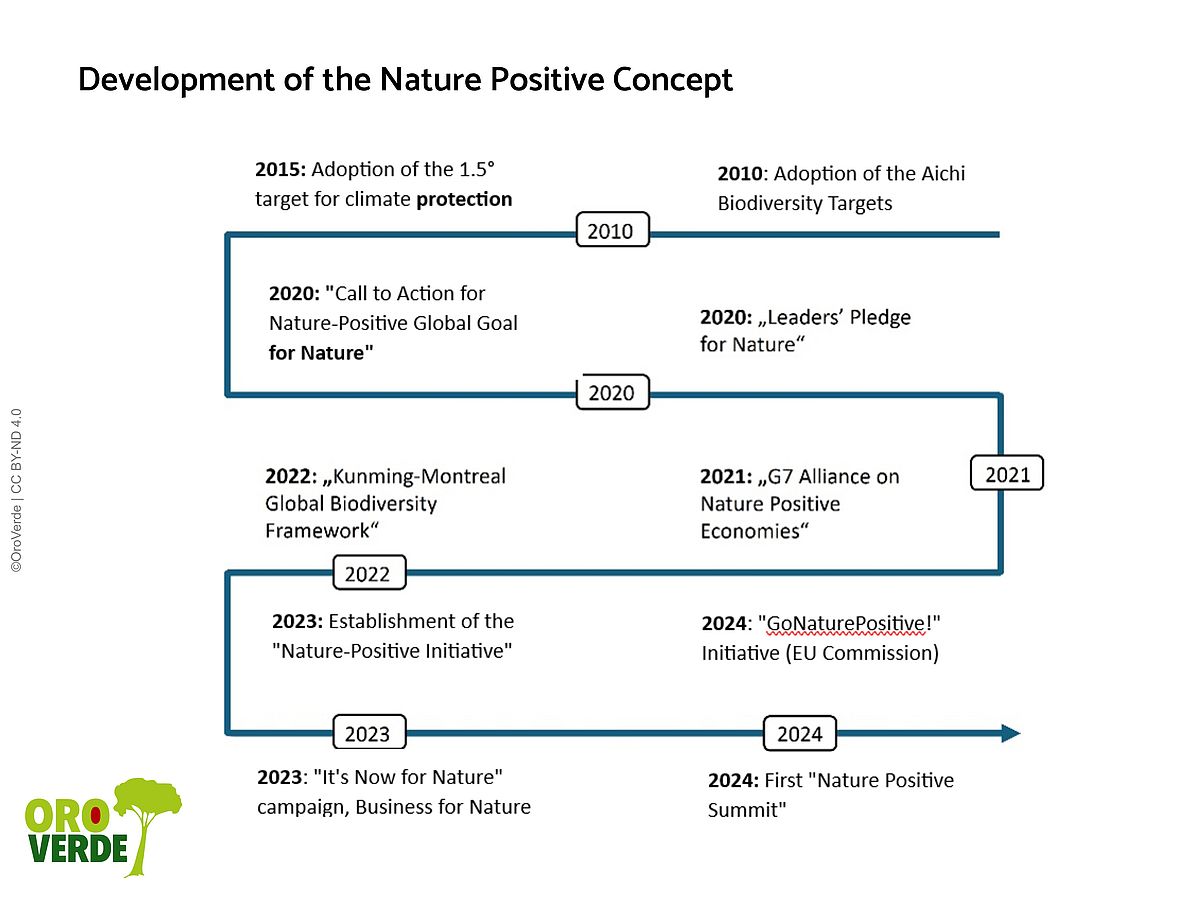
In 2020, during the coronavirus pandemic – which also highlighted the far-reaching consequences of the global loss of nature and biodiversity (Lawler et al., 2021) – Nature Positive was publicly positioned as a global goal under this concept with the "Call for Action for a Global Goal for Nature". In September of the same year, 65 heads of state signed the "Leaders' Pledge for Nature" to halt and reverse biodiversity loss for a "Nature Positive world” (The GEF, 2020). Additional states and eighty non-state actors joined in the following year. In this context, the United Nations Development Programme (UNDP) emphasised the central importance of a "Nature Positive transition" for overcoming our planet’s crises (UNDP, 2025). In 2021, the G7 also enshrined the concept by committing to reversing biodiversity loss in favour of Nature Positive as part of its 2030 strategy and by establishing an alliance for Nature Positive Business Practices. The G7 stressed that "our world must not only become climate-neutral, but also Nature Positive, for the benefit of people and the planet" (G7, 2021a).
The Kunming-Montreal Global Biodiversity Framework
The year 2022 also produced a key moment for development of the concept with the adoption of the Kunming-Montreal Global Biodiversity Framework and its signing by around 200 countries. Although the framework did not explicitly mention the concept of Nature Positive, the approach of "bending the curve", that is, not merely halting but reversing the loss of biodiversity and living in harmony with nature by 2050, was enshrined in its provisions. This is also mentioned repeatedly in the debate on Nature Positive.
The "Nature Positive Initiative" was officially established in 2023 with the participation of numerous prestigious actors such as Conservation International, Business for Nature and the WWF. this was followed in 2024 by initiatives such as the European Commission's Go Nature Positive project, the first Global Nature Positive Summit and a strong positioning of the topic at the UN Biodiversity Conference in Colombia.
The concept of Nature Positive is already widely used at international level and has gained traction in recent years, especially in the private sector, which is looking for conservation and restoration approaches centred on incentives and certification schemes (Fernández, 2022). Companies across many sectors are increasingly stating their intention to be Nature Positive alongside their net zero targets, as exhibited by a growing use of the concept in company press releases from less than 20 mentions per quarter in 2021 to over 100 per quarter in 2024 (Savage, 2024).
The United Kingdom as an example
In addition, more and more actors are supporting the Nature Positive approach, including the IUCN, the WRI and Conservation International. Aside from the 90 heads of state and government who signed the Leaders' Pledge for Nature agreement, the United Kingdom, Australia and Japan have committed to this goal at national level (The GEF, 2020). The United Kingdom can be used as an example to take a closer look at how this kind of obligation is implemented at national level. Within the Nature Positive 2030 initiative, the country's five largest nature conservation authorities have developed goals and recommendations for the areas of land and marine conservation, species conservation, agriculture, fisheries, forestry, air and water pollution, invasive species, human and natural health, and climate protection in harmony with nature conservation (Brotherton et al., 2021). Moreover, WWF UK published a paper in 2024 on the importance of Nature Positive sector-specific development pathways using the example of the agricultural sector, similar to the relevance of sector development pathways for net-zero (Ellis and Gkoumas, 2024). The topic is also closely linked to the UK's Environment Act 2021, which stipulates a biodiversity net gain (BNG) of at least 10 percent and has been a mandatory part of planning processes since 2024 (MinterEllisonRuddWatts, 2024). However, no concrete guidelines for fully implementing the objective of Nature Positive at national level have been introduced thus far.
2.2 Definition
Several definitions of the concept of "Nature Positive" exist in the English-speaking world. Many of them originate with actors who were actively involved in the development and establishment of the concept, so a large overlap in content is observable in some cases. The most frequently used definition in the English-speaking world comes from the Nature Positive Initiative:
"Nature Positive is a global societal goal defined as 'Halt and Reverse Nature Loss by 2030 on a 2020 baseline, and achieve full recovery by 2050'. To put this more simply, it means ensuring more nature in the world in 2030 than in 2020 and continued recovery after that."
"Nature Positive is a global societal goal defined as 'Halt and Reverse Nature Loss by 2030 on a 2020 baseline, and achieve full recovery by 2050'. To put this more simply, it means ensuring more nature in the world in 2030 than in 2020 and continued recovery after that."(Nature Positive Initiative, 2023)
The focus on reversing the loss of nature corresponds to the objective of the Global Biodiversity Framework and is reflected in the majority of the definitions and visualisations used.
Other interpretations of the concept, for example by the World Economic Forum, also include society as a key aspect of a Nature Positive approach (Holdorf et al., 2021). By comparison, the IUCN has adopted a far broader definition that describes Nature Positive as an inclusive summary of societal goals for nature, including the Kunming-Montreal Global Biodiversity Framework (IUCN, 2023).
The EU Business and Biodiversity Platform, provides a working definition for the concept of Nature Positive in a business context. It was developed on the basis of case studies and consultation sessions with members and identifies ten key principles of the concept. According to the definition, Nature Positive cannot be achieved individually but only in cooperation with other actors, while nature must be assessed from a holistic perspective and hence extends beyond the consideration of biodiversity. Further, the concept must follow the mitigation hierarchy and requires ambitious, evidence-based and integrated metrics, immediate action and transparent communication (Lammerant, Verhelst and Verstraeten, 2022). With its working definition of Nature Positive, the EU Business and Biodiversity Platform therefore provides significantly more concrete criteria for implementation than other definitions that have been widely used to date.
- The various definitions and applications are also increasing in line with the more widespread use of the concept. Current definitions of Nature Positive can essentially be categorised as follows:
- process-based definitions that specify operational steps without criteria for implementation,
- outcome-based definitions that refer to specific biodiversity outcomes, and
- conceptual definitions based on general concepts such as a "regenerative" economy (Zu Ermgassen et al., 2022). It becomes clear that a standardised definition of Nature Positive has not been established thus far (Milner-Gulland, 2022). This makes the current transparency in application and measurement considerably more difficult and provides scope for abuse.
2.3 Relevant actors
Numerous actors have played a key role in shaping the debate on Nature Positive and Nature Positive Business Practices in recent years – among them the World Economic Forum, Conservation International, the IUCN and other organisations. The concept has been taken up both at international political level (G7, 2021a) as well as by the private and financial sectors (McClellan, Kirchstein and Moroff, 2024).
Nature Positive in the private and financial sector
As outlined above, the issue is particularly relevant to the private sector in the area of corporate reporting and disclosure. In the financial sector, the concept of Nature Positive is connected to the question of how to mobilise more financial resources for nature conservation, especially to implement the goals of the Global Biodiversity Framework (GBF). Under GBF Target 18, the parties to the framework have committed to provide an annual US$ 200 billion to halt and reverse biodiversity loss by 2030 (CBD, 2022b). This objective is central to the concept of Nature Positive. Financial actors such as UNEP-FI or the Finance for Biodiversity Foundation (Finance for Biodiversity Foundation and UNEP, 2024), or the World Economic Forum with its Financing the Nature Positive Transition initiative (WEF, 2025a) have already embraced the concept of Nature Positive in recent years and are investigating how it can be integrated into the area of nature financing. The official launch of the Finance for Nature Positive Programme is scheduled for summer 2025. It intends, with the involvement of such as UNEP-FI and WWF, to identify Nature Positive investment options by the end of 2027 and to develop a suitable framework for investors, banks and other financial market actors (webinar announcement New Green Shoots 2025: Latest trends and innovations in nature finance, 13.02.2025; Finance for Biodiversity Foundation and UNEP, 2024). It becomes clear in this context that the concept is being discussed and embraced across sectors, which has a significant influence on the ongoing use and firm establishment of the concept.
The Nature Positive Initiative
The Nature Positive Initiative in particular plays an important role in the concept’s development and international positioning. The initiative was established in 2023, but builds on work that had been ongoing since 2019. According to the Nature Positive Initiative, the motivation behind Nature Positive stems from a group of CEOs from conservation organisations, business networks and research institutions who identified the lack of a clear and measurable goal to address the nature loss crisis and who viewed this as a major obstacle to setting targets, driving action and increasing accountability (Nature Positive Initiative, 2023). This group recognised the need for an overarching goal that could be equivalent in impact to the 1.5 degree target of the Paris Agreement and – more specifically – the pathway to net zero emissions that would make this goal achievable (Nature Positive Initiative, 2023). Hence, Nature Positive should emulate the success of "net zero" in climate protection (Weston and Greenfield, 2022). This centres on the goal of halting and reversing biodiversity loss by 2030, which is closely linked to the Kunming-Montreal Global Biodiversity Framework.
Charter members of the initiative include 27 organisations from various sectors, including nature conservation organisations such as BirdLife International, Conservation International and the WWF, research institutes such as the Potsdam Institute for Climate Impact Research and the University of Oxford, as well as business and multi-stakeholder initiatives such as Business for Nature, Capitals Coalition and the World Business Council for Sustainable Development (Nature Positive Initiative, 2025c). Representatives of the Nature Positive Initiative clarify that the initiative does not offer a definitive answer to measures to protect nature, but aims to provide a common definition across the business world and also to provide a starting point for an effective response to the current ecological crises (Lambertini and Zabey, 2023).
The World Economic Forum also plays a key role in developing and establishing the Nature Positive approach at international level. The Nature Positive Business Practices campaign was launched at the World Economic Forum Annual Meeting 2020 in Davos, and the Future of Nature and Business Report indicates the potential for Nature Positive Business Practices generating US$ 10 trillion in economic opportunities by 2030 (WEF, 2020b). Starting 2023, guidelines on the Nature Positive transition of various sectors were also developed and published in cooperation with the Oliver Wyman management consultancy firm (WEF, 2025b). What is particularly interesting about this initiative is that it also includes sectors that have a particularly pronounced negative impact on nature, including the automotive and mining industries.
Lack of inclusion
Nonetheless, development of the concept was driven by a relatively narrow spectrum of stakeholders. Critics point out that the perspectives of groups such as IPLCs, women, young people and other marginalised groups who themselves are implementing transformative change measures themselves at grassroots level are inadequately considered in the development of discussions on Nature Positive. Although IPLCs and women in particular play a central role in nature and biodiversity conservation due to the transmission of traditional knowledge, current local approaches, the importance of securing land rights and the integration of local actors, but are insufficiently represented in the Nature Positives discourse as things stand (Fernández, 2022).
3. The concept of nature
The concept of nature plays a central role in the understanding and interpretation of Nature Positive, as it is already contained in the name. Given that the delimitation and definition of nature have already been debated extensively for a long time, this chapter will set out the general categorisation of the concept of nature before explaining its interpretation within the framework of the project.
3.1 General discourse
Nature is a multi-layered concept that encompasses numerous aspects and is therefore sometimes difficult to narrow down.
Different definitions and scientific, philosophical and political interpretations of the concept are used. Given that nature is an essential part of the concept of Nature Positive, it is important for it to be considered and mapped in greater detail.
The IPBES defines nature as "natural world with an emphasis on its living components. Within the context of western science, it includes categories such as biodiversity, ecosystems (both structure and functioning), evolution, the biosphere, humankind’s shared evolutionary heritage, and biocultural diversity. Within the context of other knowledge systems, it includes categories such as Mother Earth and systems of life, and it is often viewed as inextricably linked to humans, not as a separate entity.” (IPBES, 2021). The Nature Positive Initiative uses the IPBES definition as well. The Kunming-Montreal Global Biodiversity Framework does not explicitly define nature and instead sets out a broad understanding of the concept: "Nature embodies different concepts for different people, including biodiversity, ecosystems, Mother Earth, and systems of life. Nature’s contributions to people also embody different concepts, such as ecosystem goods and services and nature’s gifts.” (CBD, 2022a). Business for Nature, one of the most important actors involved in establishing the Nature Positive concept, also proposes a broad understanding of nature. In it, "the natural world" is understood as "all natural capital, processes and natural phenomena that exist, such as fresh water, air, weather, oceans, forests, minerals, soil, organisms and mountains. These also include ecosystem services such as water filtration, pollination, climate regulation and many others. In other words: Nature is living organisms (that is, biodiversity, including humans) and their interactions with each other and with their environment, including geology, climate and all other non-living components” (Balch, Zabey and Ofosuhene-Wise, 2022). Some of these definitions provide a good overview of the broad interpretation and the aspects of nature that require consideration, but also highlight the complexity of measurement and accounting.
It is difficult to establish a rigid definition for a concept like nature, which is used in many different ways. But an unclear definition of "nature" can lead to inconsistencies in implementation by companies and in policy-making, especially when used in politically relevant international documents. Actors can exploit this lack of clarity and interpret the concept of "nature" as they wish (Monteiro Silva, 2022; Fernández, 2022), which may ultimately lead to greenwashing.
The relationship between humans and nature
The question of whether humans are part of nature is a central issue in the debate on nature and has been ongoing since antiquity. While the question of human evolution is easy to clarify and confirm from a biological perspective (Darwin, 1871), the relationship between humans and nature is viewed in more nuanced terms within philosophy and the social sciences. In the Age of Enlightenment, humans were positioned as rational beings who dominate nature, whereas modern ecology and systems theory – with James Lovelock as a relevant advocate (Lovelock, 2000) – perceive humankind as an interconnected component of the biosphere. Current studies also emphasise the relationship between humans and nature and do not consider humans in an isolated sense, but in constant interaction with the environment, in which social, cultural and ecological factors are intertwined (Schneiter, 2022). The concept of the Anthropocene (Crutzen, 2002) demonstrates that humans themselves are also profoundly intervening in and changing nature. This interaction must be taken into account when interpreting the concept of nature, for example in connection with the concept of Nature Positive.
3.2 Conclusions for Nature Positive
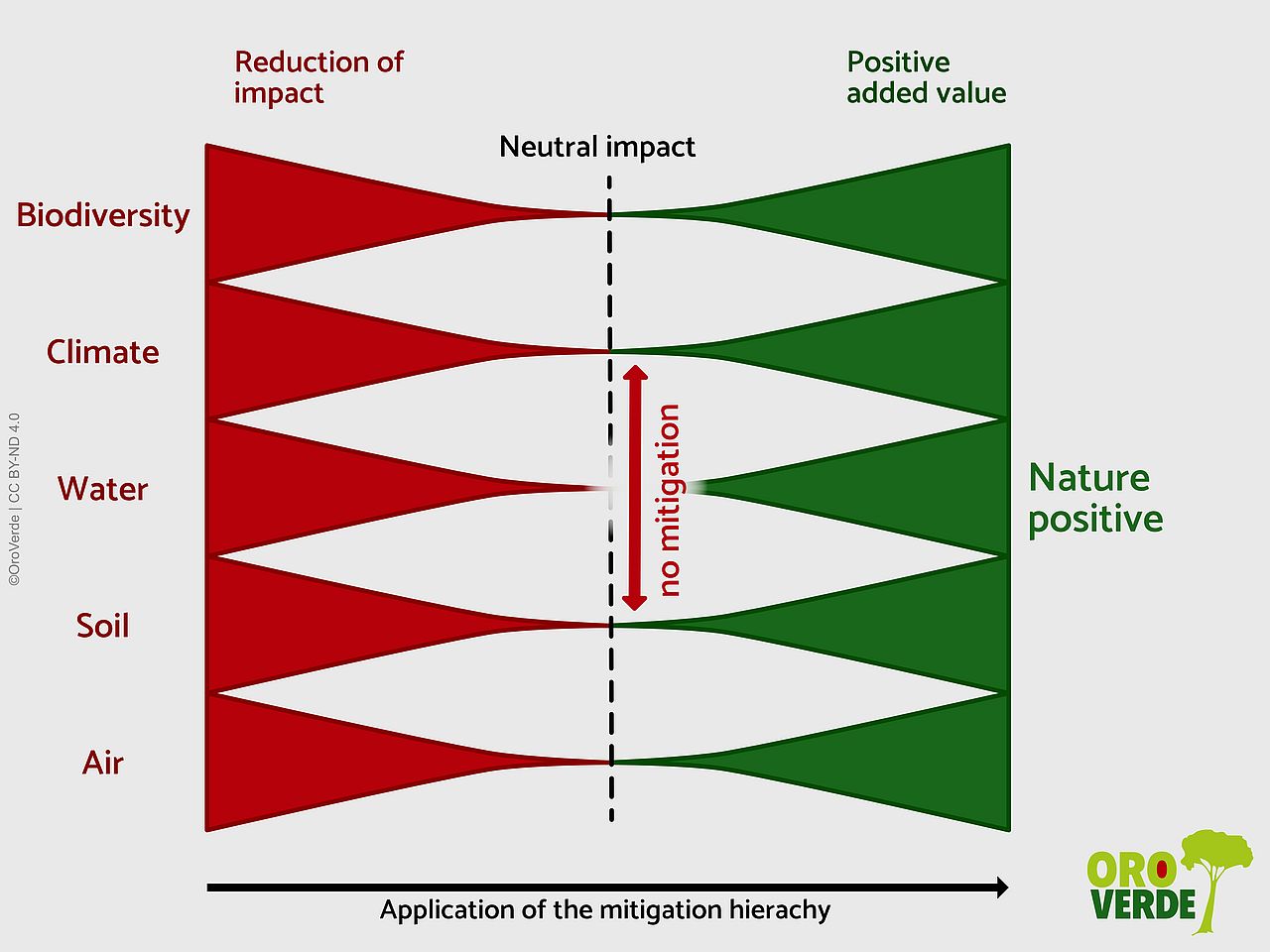
Over the course of the project, the approach of breaking down nature into individual dimensions for the concept of Nature Positive proved auspicious, based on expert opinions from interviews and workshops. This is also consistent with the recommendation issued by the EU Business and Biodiversity Platform (Lammerant, Verhelst and Verstraeten, 2022). The aspects of climate, biodiversity, soil, water, forest and air were identified as potential key dimensions, which also reflect elements of the above definitions. While the terms concepts of and biodiversity are often used synonymously in the general debate (despite their different technical definitions), biodiversity has been emphasised as an essential basis for many ecosystem functions and thus as a central dimension of the concept of nature in the project work to date. Biodiversity plays a key role here, as it must also be taken into account in the other dimensions of nature. This differentiation of the concept of nature based on individual dimensions is also revealed in the issue of measurement, which will be addressed later on in the discussion paper.
In line with the above scientific interpretation, humans should also be perceived as part of nature in the context of Nature Positive. This is because human activity, especially economic activity, has a major impact on the integrity of nature and is, at the same time, highly dependent on the intactness of nature. A transformative concept – such as the envisaged Nature Positive approach – can only be successful if people view themselves as part of nature and realise their own interaction with nature. This applies in particular to economic activity that is highly dependent on the intactness of nature and which has not yet been addressed sufficiently in societal debate.
Local context and landscape approach
Furthermore, the discourse accompanying the project made clear that nature in the context of Nature Positive must always be considered in a local and regional context, as ecological systems and their interrelationships are locationally dependent. This interpretation has particular implications for the measurement and assessment of Nature Positive as well. The landscape approach also plays an important role in this context, which, aside from the social component, can also take ecological relationships and cycles into account.
Landscape approaches consider the interactions between humans and nature in places where productive land use – such as agriculture, livestock farming and mining – may come into conflict with nature and biodiversity objectives. These systems-based approaches seek to allocate and manage land in a way that simultaneously achieves social, economic and environmental goals while preserving ecosystems and the essential services they provide (Landscapes for Our Future, 2025). They enable the formulation of compromises to utilise available potential at landscape level for the benefit of the population, but without jeopardising current natural resources. They also strike a balance between the interests of different user groups and the social goals of ecological sustainability (Schütz, 2019). If implemented successfully, this kind of approach can address systemic problems such as deforestation, biodiversity loss, poverty and sustainable development at landscape level, which individual actors would usually be unable to resolve on their own (Pedroza Arceo and Kosciulek, 2023).
Interpreting nature in this way in the context of Nature Positive Business Practices might help to make nature more tangible and easier to communicate despite its complexity. This would also contribute to establishing a narrative in social discourse that makes nature and its significance more accessible.
4. Impact measurement
Impact measurement is also highly relevant to the debate on Nature Positivity and Nature Positive Business Practices. It reveals central challenges and points of criticism. Parallel to the chapter on the concept of nature, the general discourse on measuring impact on nature will first be analysed, following by an outline of its interpretation in the context of the project.
4.1 General discourse
The concept of Nature Positive promises a positive impact on nature. However, this raises the question of how this kind of impact can be measured and verified.
Accounting for nature has been long been the subject of discussion in the context of corporate reporting. In the early 2000s, the focus here was placed, in response to corporate scandals, on the aspect of financial transparency in particular (Quick, 2022), which led to the introduction of International Financial Reporting Standards (IFRS) as the benchmark for financial reporting (IFRS, 2025). ESG and sustainability reporting has gained in importance over the past decade, for example through EU transparency guidelines for good corporate governance and risk reporting (European Commission, 2024a). GRI (Global Reporting Initiative) standards were increasingly applied in this context (GRI, 2022). More and more companies have also committed to CO2 reduction and reporting in response to the climate debate. Establishment of the Task Force on Climate-related Financial Disclosure (TCFD) and the Science Based Targets Initiative (SBTI) led to the creation of initiatives to provide companies with guidance on climate protection and reporting (FSB, 2015; Khan, 2023).
Obligation in reporting
While the majority of ESG approaches originated as voluntary corporate commitments, sustainability reporting obligations increased from around 2020, particularly as part of the European Green Deal (Hummel and Jobst, 2024). With the EU taxonomy, a classification system entered into force in 2022 that defines which economic activities are considered environmentally sustainable. The taxonomy aims to promote investment in environmentally friendly projects and prevent greenwashing (European Commission, 2020) and is closely linked to implementation of the CSRD (Corporate Sustainability Reporting Directive). The CSRD is an EU directive that expands the sustainability reporting requirements for large and medium-sized enterprises. Entering into force on 5 January 2023, transposition into national law was required by July 2024. But Germany did not meet this deadline, so implementation is expected in 2025. The CSRD requires companies to disclose detailed information on environmental, social and governance aspects, including their impact on nature and biodiversity (Federal Ministry of Justice, 2023, European Parliament and Council of the European Union, 2022). The ESRS (European Sustainability Reporting Standards) sets out binding reporting standards that define the requirements and content of these sustainability reports. ESRS 4 includes the topics of nature and biodiversity, which stipulate that companies must report on their risks, impacts and measures relating to ecosystems, land use and biodiversity (European Commission, 2023). In February 2025, the European Commission published a proposal for the so-called Omnibus Regulation, which is intended to combine the obligations of the CSRD, the Supply Chain Directive (Corporate Sustainability Due Diligence Directive, CSDDD), the Taxonomy Regulation and the Sustainable Finance Disclosure Regulation (SFDR) in order to reduce the bureaucratic burden on companies (EMAS, 2025). Overlapping reporting obligations will be adjusted and the reporting process simplified. However, critics fear that the corporate due diligence obligations for compliance with human rights and environmental protection standards will be curtailed and voice concerns about the lack of transparency in the Commission's procedure (Diendorfer, 2025). The proposals are currently under review by the European Parliament and the Council.
Global initiatives for sustainability reporting
At international level, a committee of the IFRS Foundation created new global standards for sustainability reporting in 2023. These were enshrined in the ISSB standards, which had previously contained general and climate-related requirements for corporate disclosure (IFRS, 2023). Overall, corporate reporting has evolved over recent decades from focusing manly on financial aspects towards a mandatory, digitalised and ESG-oriented interpretation.
Methodological approaches to impact measurement
These developments are also reflected in a variety of methodological approaches to measuring nature. The United Nations, for example, created the System of Environmental-Economic Accounting – Ecosystem Accounting (SEEA EA), which establishes a standardised system for valuing natural resources and ecosystem services and is used for political decision-making processes in over 34 countries (SEEA, 2025). The Capitals Coalition 's Natural Capital Protocol (NCP) provides a framework for companies to value nature in monetary and non-monetary terms and in doing so incorporate natural capital into business decisions (Natural Capital Coalition, 2016). Some large companies use the NCP for their accounting and reporting. Another important entity is the Task Force on Nature-related Financial Disclosure (TNFD), which expands the Task Force on Climate-related Financial Disclosure (TCFD) to include nature aspects and is supported by well-known actors such as UNEP, UNDP and Global Canopy. It provides guidance on reporting on nature and biodiversity, based on an analysis of dependencies and impacts on nature (TNFD, 2025). The entire debate on the valuation of ecosystem services is also a material aspect in today's frameworks and approaches to measuring nature. Studies on the topic have recommended viewing nature and its services as capital for society (Schwaiger et al., 2015), which was also reflected, for example, in the EU's 2011 biodiversity strategy in the mapping and assessment of ecosystem services (Academy for Territorial Development in the Leibniz Association, 2018). The measurement of nature also focuses on ecosystem services and the reciprocal relationship with human activity.
Overall, there are a large number of other instruments for valuing nature (including Exploring Natural Capital Opportunities, Risks and Exposure (ENCORE), Trase; Aligning accounting approaches for nature), which cannot be presented in full at this point. Biodiversity in particular is a highly complex aspect in the measurement of nature and one that is not adequately accounted for by all frameworks. Nonetheless, specific methods for measuring this aspect have also been developed, including the Integrated Biodiversity Assessment Tool (IBAT) from UNEP and IUCN, the Global Biodiversity Score (GBS) from CDC Biodiversité and the Corporate Biodiversity Footprint (CBF). The Global Nature Fund also plays an important role in this regard in the development of biodiversity criteria and guidelines at the level of individual companies and sectors (e.g. Business and Biodiversity, 2023; Hammerl et al., 2023).
The Nature Positive Initiative is developing metrics for valuing nature and, specifically, Nature Positive as well. To this end, the initiative launched a consolidation process with experts in 2024 and in January 2025 published a recommendation of suitable metrics, the "State of Nature Metrics” (Nature Positive Initiative, 2025a). These metrics relate to living organisms and biodiversity as a proxy for the overall state of nature. At present, the focus is still on terrestrial ecosystems. They introduce a set of four general (ecosystem extent, site conditions, landscape conditions, risk of species extinction) and five case-specific indicators (extent of priority ecosystems, proportion of semi-natural habitats, condition of priority ecosystems, condition of semi-natural habitats, species population abundance). Each indicator is assigned metrics at three levels (entry level, standard, advanced), as well as criteria for application. The recommendation of the Nature Positive Initiative is only intended as a minimum standard and should be specifically expanded depending on the context of the company. The metrics will be piloted in 2025 and, if necessary, adapted so that final recommendations can be incorporated into standards in 2026 (Nature Positive Initiative, 2025a). The year 2020 is taken as the baseline here, and the measurement will be performed on a location-specific basis using freely available data. Only indicators for land ecosystems have been developed so far, but further consolidation with experts for freshwater ecosystems and oceans is currently ongoing (Nature Positive Initiative, 2025b).
Technology use in impact measurement
In addition to site-specific data collection, the use of satellite data is also of considerable importance for the measurement and evaluation of nature, as in some cases complex natural relationships can already be observed and evaluated using freely available data (Purvis et al., 2019; Ghasemi, Latifi and Pourhashemi, 2024). Artificial intelligence and the associated automated analysis of data are also playing an increasing role in measurement and reporting, for example in the evaluation of satellite data, biodiversity indices or risk modelling (Columbia University, 2024).
Challenges of the "positive" impact
Aside from the general issue of measuring nature, the concept of Nature Positive also raises a discussion about the intended positive impact.
On the one hand, it is important to clarify whether economic activity – which is largely based on the use of natural resources, depending on the sector – can have any positive impact on nature, or whether the impact can be minimised and potentially neutralised at most. In most sectors, economic growth – which continues to be a political objective – is associated with increasing resource consumption, which is difficult to reconcile with a positive impact on nature. Moreover, any discussion of a positive impact on nature or the climate at product level would be controversial, as a consumer may be told that more consumption would lead to an even greater positive impact (DUH, 2024b). But evidence has pointed to the fact that reducing consumption and improving the durability and reusability of products is a cornerstone of sustainable transformation of the economy and society (Lehmann and Huber, 2022).
On the other hand, the concept of Nature Positive can be interpreted as a net-positive approach to nature. While the definition of the Nature Positive Initiative makes no explicit reference to “net positive", the detailed explanation states: “Delivering the Nature Positive goal requires measurable net-positive biodiversity outcomes through the improvement in the abundance, diversity, integrity and resilience of species, ecosystems and natural processes” (Nature Positive Initiative, 2023). The net-positive approach to nature is not new, but emerged in the early 2000s in extractive industries such as mining, which found themselves under pressure to compensate for their massive environmental impact in ways that extended beyond mere damage limitation. A well-known example of this is the mining company Rio Tinto, which, under the Net Positive Impact (NPI) approach, endeavoured to restore more nature through renaturation measures than it damaged with its mining activities (Vyawahare, 2019). Over the following years, the NPI approach was increasingly adopted by governments, companies and organisations, particularly in relation to biodiversity (NPI Alliance, 2015), and was expanded over time to include social and governance-related aspects (The Climate Group, 2014).
The problem of compensation
The main criticism of the net-positive approach to biodiversity lies in its implication that continued destruction of biodiversity is unavoidable and can be compensated for by ecological restoration (Monteiro Silva, 2022). This compensation should be greater than the lost areas, ecosystems or species populations, hence yielding a "net positive" for biodiversity (Fernández, 2022). A "net" approach would therefore mean that continued loss of nature would be acceptable as long as it is compensated for elsewhere, including through offset mechanisms, and hence nature can be restored at will (Milner-Gulland, 2022). Critics point out a number of problems with this approach, as it fails to account for the loss of ecosystem functions and ignores the biological and cultural uniqueness of ecosystems, species and areas, sets unrealistically high targets for habitat restoration and compensation for ecological restoration, and remains unclear as to whether the compensation area would actually have been lost. In addition, as with carbon offsetting measures in the climate debate, there is a risk of negative impacts on indigenous peoples, local communities, women, youth and other vulnerable groups, who are often inadequately consulted in the design of offset programmes (Fernández, 2022). What is more, biodiversity offsets in particular are often beset with problems relating to their design, implementation and integrity (Maron et al., 2023). A fundamental criticism of biodiversity compensation is that it reduces complex life forms to a marketable statistic without any inherent value, while suppressing any intrinsic motivations to protect nature (Karlsson and Edvardsson Björnberg, 2021). Other challenges include doubts about the extent to which compensation measures are effective in achieving their stated goal of causing at least no net loss of biodiversity (Maron et al., 2025), as well as inadequate methods and metrics in regard to measurement. Significant investments are also required for monitoring and administration. At the same time, the mechanisms for ensuring the long-term effect of biodiversity conservation measures are limited (Chandrasekhar, 2023) and it is viewed as difficult or even impossible to replace site-specific biodiversity (Björnberg, 2020).
The issue of how compensation is implemented is crucial in this context in order to achieve a net positive balance for nature. There is also widespread criticism of the implementation of climate compensation measures in the climate debate, as these frequently remain unaccompanied by an initial reduction in emissions, the long-term effect and additionality of many compensation projects is not guaranteed, there is a lack of monitoring and transparency in their implementation and they often have negative social and ecological consequences at local level (German Environment Agency, 2018; Kind et al., 2010). Similar challenges may also arise in connection with compensation measures for nature.
Distribution issues and social justice
Moreover, measures that have a generally positive impact on nature may produce unequal outcomes for different social groups due to their varying dependence on aspects of nature. This raises the following question as to who actually benefits from a positive effect (Zu Ermgassen et al., 2022), especially if local actors are insufficiently included in the planning and implementation of compensation measures.
4.2 Conclusions for Nature Positive
The topic of impact and its measurement in the context of Nature Positive was also a critical point of discussion in the project, as it may be associated with major risks. Given the complexity of impact measurement due to the broad potential interpretation of the concept of nature, the expert dialogue yielded the recommendation to break down the measurement into nature dimensions in parallel to the definition of nature (see above). It is important to consider the dimensions individually and not to allow any equalisation between them, which prevents the emergence of a net positive outcome despite a negative impact in individual dimensions (cf. also Lammerant, Verhelst and Verstraeten, 2022). As mentioned earlier, a large number of frameworks for measuring and accounting for nature currently exist or are in preparation (e.g. Nature Positive Initiative, SBTN, TNFD, Align). The challenge lies not in the lack of suitable metrics, but in the number of parallel initiatives that require greater clarity and standardised recommendations. Nevertheless, specific metrics can be defined that might yield sector-specific recommendations in the long term, depending on a company's sphere of influence. As sufficient data is not always available, it is important to explore how its availability can be improved and in which aspects qualitative assessments would initially be necessary.
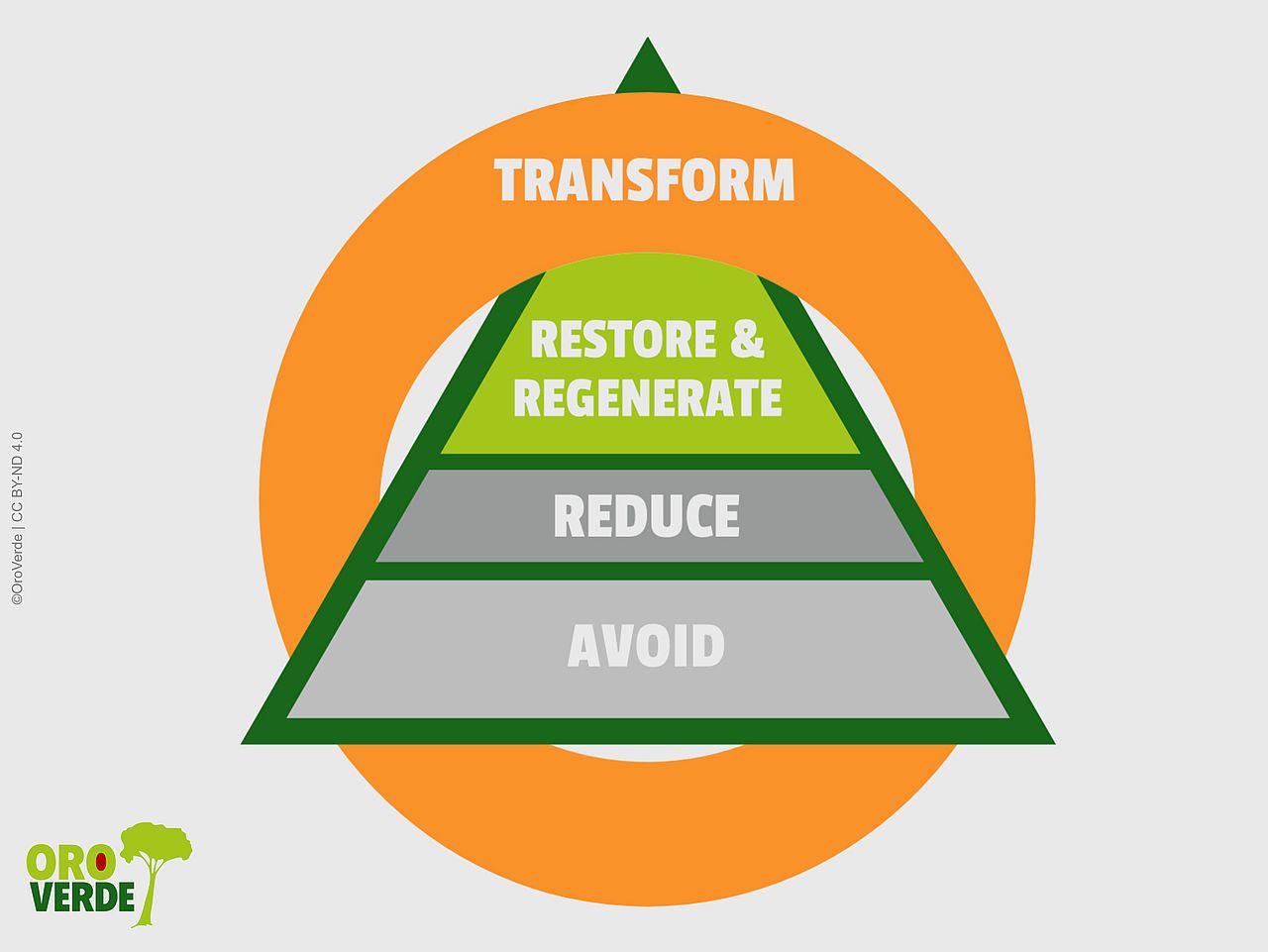
1) Avoidance and reduction of nature loss; 2) Restoration and regeneration of nature; 3) Transformation of fundamental systems at multiple levels to withstand drivers of nature loss (based on Klein, 2021).
Mitigation hierarchy as a central foundation
The mitigation hierarchy should lay the foundation for reducing negative impacts and for Nature Positive Business Practices (cf. also Lammerant, Verhelst and Verstraeten, 2022). It prioritises the avoidance and reduction of impacts on nature before restoration and compensation of negative impacts are allowed to take place. Moreover, aspects such as recyclability and disposal should be taken into account in the avoidance and reduction steps already, as envisaged, for example, in the cradle-to-cradle principle. Approaches such as Science Based Targets for Nature supplement this hierarchy by adding the aspect of transformation, which encourages cross-sector collaboration.
This concept harbours considerable potential for Nature Positive Business Practices. As a rule, each actor has, within their own sphere of influence and portfolio, the potential to minimise the loss of nature and contribute to its restoration. This requires a detailed analysis of the company's own business activities in order to identify specific levers for reducing negative effects. The focus should be placed on an actor’s core business instead of concentrating on easily realisable side projects, as is still commonly encountered in practice.
Selecting the baseline: Status quo
Selecting the baseline is a central issue in the measurement. International definitions of Nature Positive often refer to the year 2020 as a baseline (see Nature Positive Initiative). Two possible approaches were discussed at the project's expert workshop: a future-oriented baseline reflecting an ideal state of nature, or a baseline according to the status quo in a specific year. However, actors may decide on the latter so that improvements would be easy to achieve without major changes, thus diluting the concept. A tendency towards an ideal-state baseline emerged in the discussion. This would refer to nature at a defined location and render measurable a contribution to progress towards this target state. The selection of ambitious, scientifically sound and integrated metrics is also crucial here (Lammerant, Verhelst and Verstraeten, 2022). Building on this, a step-by-step implementation could take place according to the mitigation hierarchy – initially by avoiding and reducing negative impacts, followed by transformative measures and finally compensation.
Significance and limits of compensation
The aspect of compensation nevertheless plays an important role in the debate. Many economic activities are accompanied by a certain unavoidable negative impact on nature. It is therefore essential to determine exactly which damage is actually unavoidable in order to completely avoid and reduce all avoidable impacts in the first step. The lion’s share of financial resources should be channelled into this avoidance process. Without this prioritisation, the focus might shift excessively towards compensation, without full implementation of upstream avoidance measures. Compensation offsets existing losses, thus opening the door to a neutral balance, in theory at least. However, "overcompensation" would be required that contributes to the restoration of nature in order to achieve a Nature Positive balance. It is important to bear in mind that certain losses of nature – including genetic diversity or ecosystem services – cannot be fully compensated for elsewhere. In principle, the compensation of damage should be considered for each key dimension and, if possible, implemented locally where the damage actually occurs. Compensation at other locations or outside an actor’s sphere of influence should only take place to a subordinate extent and be communicated in a nuanced manner (e.g. by categorising the value of compensation measures). Here, the debate on compensation differs fundamentally from the climate debate, as impacts on nature possess a strong local and regional relevance. In contrast to the climate system, impacts on nature cannot simply be considered, on aggregate, at global level, which means that compensation measures must be implemented locally.
5. Risks and potential of the concept
Depending on how it is interpreted and used, the concept of Nature Positive is associated with extensive risks – which are already under discussion at international level in particular – but also with potentials that may be central to ongoing sustainable design and provide direction.
5.1 Risks and criticism
Despite the positive intention of the concept and its anchoring at international level, it has also been widely criticised. A key point is the unclear definition mentioned above, which hinders standardised use and verification and offers sparse concrete approaches for implementation. Initiatives such as the Nature Positive Initiative are also voluntary and the concept is not yet legally binding. According to The Guardian, more than 10 organisations that use the concept of Nature Positive define it in different ways, and there is scarce guidance on how it should be implemented (Weston and Greenfield, 2022). Even respected nature conservation organisations already use the concept too broadly in some cases and reduce it to a few aspects without considering the holistic approach (Maron et al., 2023).
The risk of greenwashing
This is the most frequently cited risk associated with use of the concept, namely its potential exploitation by companies and other actors for the purpose of greenwashing, rather than taking it as a guide for changing the impact of their actions on nature (Fernández, 2022; Zu Ermgassen et al., 2022) – a risk that is also acknowledged by actors in the Nature Positive Initiative (Lambertini and Zabey, 2023). In this context, nature conservation groups fear that companies are increasingly using the concept as a label to claim that you can now make “Nature Positive” investments, book a “Nature Positive” holiday or buy a “Nature Positive” coffee (Savage, 2024), without legally binding standards to safeguard accountability. Business for Nature, one of the pre-eminent organisations endorsing the concept of nature-positivity, therefore also recommends that companies perceive and use Nature Positive as a goal and not as a slogan (Savage, 2024). These ambiguities with regard to definition, use and measurement can therefore lead to a dilution of the concept and even abuse.
Criticism of the net-positive approach
What is more, as addressed earlier in detail under the aspect of impact measurement, the concept is based on a net-positive approach in which the destruction of nature in one place should be offset by conservation measures elsewhere. Scientists consider this approach to be problematic, as ecosystems often cannot be simply replaced (Apostolopoulou and Adams, 2017).
Critics such as the Green Finance Observatory also warn against the financialisation of nature, in which biodiversity is integrated into market-oriented systems without the focus being placed on actual protection (Green Finance Observatory, 2022). This argument is part of a wider debate that underpins the measurement, accounting and economic valuation of nature, and also plays into the concept of Nature Positive. For this reason, some of the most prominent proponents of the concept do not see it as inherently problematic in itself, but rather the potential "danger that its meaning will be diluted and no longer focus on the measurable net gain in biodiversity and instead just on measures that benefit nature” (Milner-Gulland, 2022).
Measurement challenges
Furthermore, the measurement of nature remains complex, especially within such an ambitious concept as Nature Positive. Critics argue that although the idea of Nature Positive is easy to sell, the promise is excessive due to the momentary absence of a measurement method (Monteiro Silva, 2022). Given the lack of a global standard for measuring biodiversity, companies and other actors could – intentionally or otherwise – manipulate data to present themselves as nature-friendly without significantly changing their customary business activities (Savage, 2024). In order to avoid this risk in measurement, it is important to bring together uniform and suitable standards for measuring dimensions of nature, put forward concrete recommendations and improve data availability. Nevertheless, aspects such as the loss of genetic diversity and complex local ecosystem services cannot be fully restored and compensated for, which stands in the way of actually being Nature Positive.
Exclusion of groups
Another bone of contention is the lack of inclusion of IPLCs (Indigenous People and Local Communities), women, young people and other marginalised groups in the discourse. Despite the immense significance of these actors for nature and biodiversity conservation, their traditional knowledge and practice, as well as their protection, have n inadequate inclusion within the Nature Positive approach thus far, and they often remain excluded from these sources of funding despite the mobilisation of fresh financial resources for nature conservation (Fernández, 2022). Instead, the development of Nature Positive is primarily driven by major international actors and is increasingly seeping into the private and financial sectors.
5.2 Potentials
Considerable potential is nonetheless associated with the concept. For instance, it permits a holistic perception of the impact of economic activity, moving away from focussing solely on climate aspects and towards a broad consideration of the effects on nature. This is where the transformative potential of the concept lies (Zu Ermgassen et al., 2022). A transformation of this kind, which considers the system as a whole, has also been increasingly called for at international level in recent years, also by the G7, which is demanding a system change to net zero and Nature Positive (G7, 2021b). Even the broad scope of the European Green Deal for economic transformation towards climate neutrality in Europe – with its multitude of legislative proposals and increasing consideration of complex interrelationships in international supply chains – also indicates how important this kind of system analysis would be (Heidegger, 2024).
Restoration of nature
Further potential lies in the topic of nature restoration, which is firmly enshrined in the objectives of the Global Biodiversity Framework and is also addressed by the concept of Nature Positive. Around 40 percent of the world's land area is currently considered degraded, with an additional 100 million hectares of land adding to this total each year (UNCCD, 2024). Around three billion people worldwide are affected by the consequences of land degradation, which is causing increasing migration and instability in communities in many regions (Dickinson, 2024). The restoration of degraded land is underfunded and requires a fourfold increase in funding from US$ 64 billion in 2022 to US$ 296 billion in 2030 to achieve global restoration targets while contributing to climate and biodiversity goals. Governments currently provide just under three quarters of the funding for restoration, meaning that private sector capital needs to be mobilised as well (United Nations Environment Programme, 2024). Restoring nature is enshrined, among other things, in the EU Nature Restoration Regulation, which entered into force in 2024 and sets specific targets for the restoration of degraded ecosystems, habitats and species for land and marine areas (European Commission. Directorate-General for Environment, 2025). Broad and effective implementation of a Nature Positive concept could provide funds for the regeneration and restoration of nature, as it is important to achieve positive added value for nature. There is great potential here to unite global objectives for climate and nature conservation, but also for the regeneration of nature, and to create momentum.
Nature Positive as an integrative approach
An additional added value of the concept of Nature Positive can be seen in the fact that different sustainable economic approaches such as the donut model (Raworth, 2017), the circular economy (European Parliament, 2023), and the cradle-to-cradle approach (Federal Environment Agency, 2023), green economy (Federal Environment Agency, 2024) and regenerative economy (GLS Crowd, 2024) can all be brought together within this concept. In this way, it might contribute to a reorientation of the discussion and a more comprehensive transformation approach that connects individual theories instead of perceiving them as rivals to be exploited. However, with regard to potential Nature Positive Business Practices, it is also important to question unlimited economic growth in the sense of a sufficiency economy (Ekardt, 2016) and, at the same time, to strive for a reduction and more sustainable organisation of consumption.
The concept of Nature Positivity, here in relation to Nature Positive Business Practices, therefore closes a gap in the development of sustainability concepts: the previous widespread focus on climate impacts is expanded to include impacts on nature, so that damage must be considered from a holistic viewpoint, including systemic interactions. The concept also reflects the need to contribute to the restoration of nature and its long-term recovery, rather than just aiming for a neutralising effect. Therein lies the considerable potential inherent to the concept of Nature Positive for the international debate, namely as a hitherto absent, overarching ultimate goal for nature (Weston and Greenfield, 2022). At the same time, there is a certain risk if the concept is misused or applied too vaguely, as Nature Positive already describes an ideal state.
6. Conclusions
Initial findings have emerged from the project work to date, particularly in dialogue with various experts, which are presented below. For example, a proposal for the continued development of the concept of Nature Positive Business Practices at a political level was prepared. It is presented here in its initial stages and will subsequently be further developed. Recommendations for companies are given as well, and the topic is briefly categorised for German-speaking countries based on case studies, and an outlook on possible further development potential is provided.
6.1 Proposal for understanding the concept
As part of the research and the expert dialogue during the project, the concept of Nature Positive Business Practices and their potential use was considered at various levels of application – from individual companies to economic sectors and the economy as a whole.
No label at individual level
With a view to the complexity of the concept as described above and the associated risks, particularly with regard to measurement and verification, the project came to the conclusion that: The term is not suitable as a label or standard for individual actors, supply chains or products and should not be developed in this direction. This assessment builds in particular on the current use of the concept, including the lack of a definition for concrete implementation and clear metrics, which might promote misuse of the concept, including greenwashing. Due to its complexity and lack of clarity, the concept would pose major challenges for individual actors, especially in the context of the currently available guidelines on the use of sustainability terms and transparency standards. The project is not alone in this assessment; actors such as Business before Nature also share the view that a company or organisation should refrain from describing itself as Nature Positive, but should instead take specific measures to contribute to a Nature Positive world (Balch, Zabey and Ofosuhene-Wise, 2022). The EU Business and Biodiversity Platform also states that it is almost impossible for companies to become Nature Positive, but that every actor can nevertheless contribute to the overall global goal, as reversing nature loss requires a comprehensive societal approach (Lammerant, Verhelst and Verstraeten, 2022).
Politics as a central application level
While its use as a label at individual level is therefore not recommended, the term has already been widely established, similar to the 1.5°C climate target, as a global goal for nature conservation at political level, and countries have already committed to the concept. The realisation also emerged during the project that Nature Positive Business Practices can unleash their greatest potential at political level and should serve as an overarching vision and guiding principle to which various sectors and individual actors can contribute.
By adopting an orientation of this kind, the concept could act as a beacon for the direction of necessary economic transformation and at the same time counteract dilution or misuse at individual level. This model would thus describe an ideal state in which it is still necessary to define on the basis of the specific design whether it can actually be achieved or should instead act as a forward-looking ideal.
Within an interpretation of this kind, individual actors are unable to operate entirely in line with Nature Positive Business Practices, but can nevertheless contribute to a Nature Positive transformation. This transformation could be broken down into sector visions that contain specific objectives relating to relevant dimensions of nature, recommend appropriate metrics and enable actors to measure their specific contribution. This recommendation is in line with the concept of Nature Positive sector-specific development pathways, which are also endorsed by actors such as the WWF and the World Economic Forum (Ellis and Gkoumas, 2024). The focus should be on taking incremental measures along the mitigation hierarchy that work towards this goal and on identifying specific options for actors to take action.
In this context, it would also be possible to answer the question of which actors and sectors can even be Nature Positive, which has repeatedly been the subject of critical discussion in this context. This makes clear that certain industries – including lignite mining – cannot be part of a future Nature Positive Business Practices, as the destruction they cause across various dimensions of nature is simply too great to be fully compensated for in the end. Nevertheless, based on the mitigation hierarchy, these industries can make a significant contribution to reducing impacts on nature and also a certain local compensation during the initial phase of transformation. The concept of Nature Positive must therefore be designed as an inclusive, cross-sectoral model that permits macroeconomic transformation and does not again focus on individual aspects, sectors or actors.
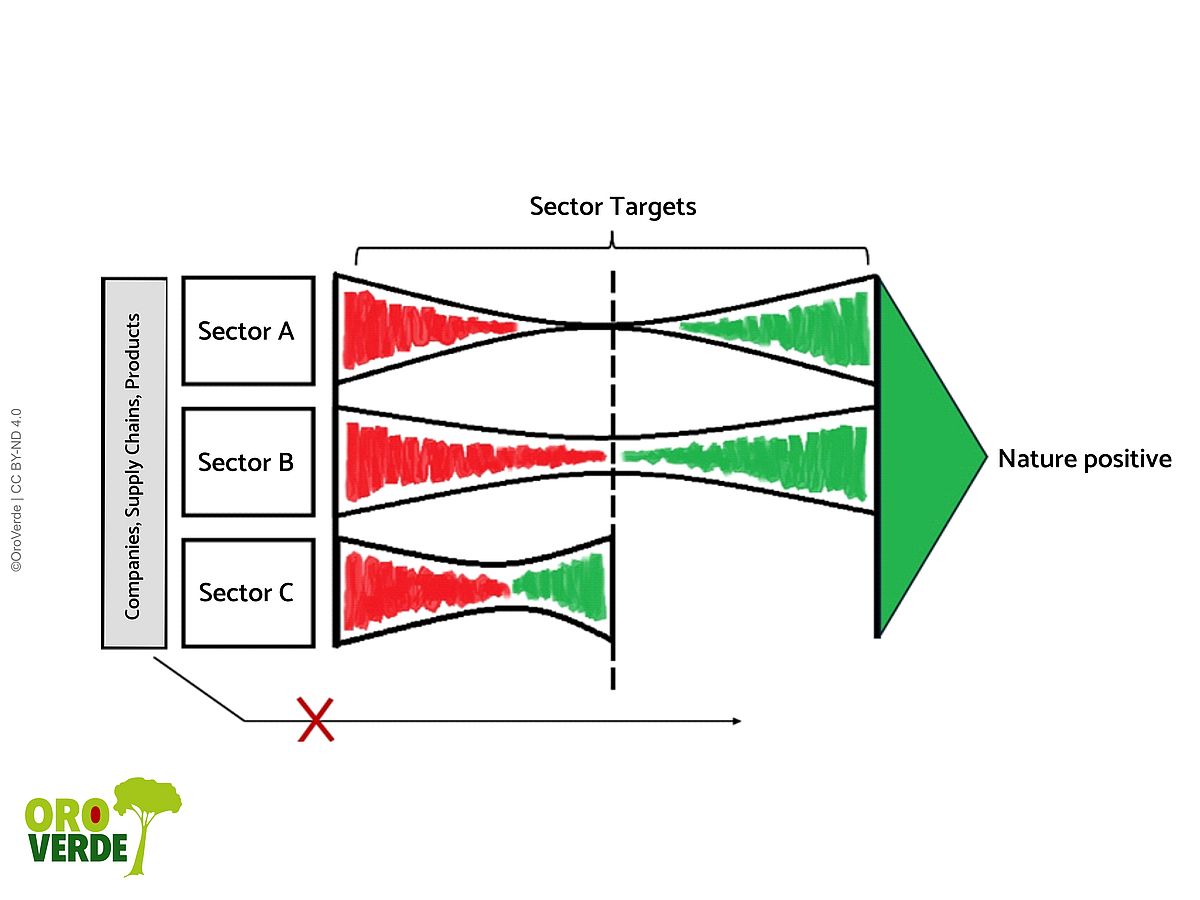
Individual sectors can set specific targets and in doing so contribute to a macroeconomic vision of Nature Positive. Individual companies, supply chains or products contribute indirectly via their sectors, but cannot themselves be explicitly Nature Positive. A sector target adheres to the mitigation hierarchy, in which negative impacts are first avoided and reduced as far as possible before restoration takes place. Depending on the sector, a negative impact can be completely avoided (sector A) or reduced to a minimum (sector B) prior to compensation and restoration. Individual sectors can contribute to a certain extent by reducing negative impacts and restoring at local level, but ultimately cannot themselves become completely Nature Positive and be part of a Nature Positive future (sector C).
A holistic model for the economy and society
Given that humans are part of nature and hence belong to the concept of Nature Positive as well, it also harbours potential for society to consider all human activity in addition to the economy, to embrace a holistic evaluation and ultimately, as called for in the Global Biodiversity Framework, to find a way to live in harmony with nature by 2050 (CBD, 2022a).
This possible interpretation and use of the concept of Nature Positive as a model for business practices should also take into account the aspect of consciously reducing and changing production and consumption patterns along the lines of a sufficiency economy (Deutscher Bundestag, 2024).
6.2 Recommendations for companies
Even if the project findings indicate that the Nature Positive concept is not recommended as a label at the level of individual companies, supply chains and products, the concept still harbours potential for companies. For example, Nature Positive advocates a holistic approach to impact measurement and improvement, which expands the previous focus on individual impact factors – climate impacts in particular – to include broader effects on nature and focuses on nature as a whole. Companies can also apply this broader view of impact to their specific sphere of influence, but should always refer to their own core business. For such an analysis, the concept of nature can also be broken down into individual dimensions of nature and render the effects on nature measurable. It is not possible to make specific recommendations on suitable metrics at this point, as they are highly sector-dependent. However, as mentioned earlier, a large number of instruments and metrics exist for measurement that need to be brought together and translated into sector-specific recommendations.
Adjustments on the company’s side should always be made in line with the mitigation hierarchy, which means that the first priority is to minimise negative impacts as far as possible and then to reduce them. Only then should measures be taken to restore and regenerate individual dimensions of nature. This compensation should take place as locally as possible, where the damage occurs, and not be outsourced. It is in this aspect of restoration that the concept presents additional potential for companies that analyse their sphere of influence to identify opportunities for regeneration and in doing so can contribute to the long-term recovery of natural resources. This means that Nature Positive can also serve as an overarching model for companies and as an unattainable ideal state that offers direction for development and orientation. Nevertheless, a company should neither describe or advertise itself nor its supply chains or products as Nature Positive.
6.3 Nature Positive in German-speaking countries
The concept of Nature Positive is already firmly established at international level, despite its varying and largely vague definitions. The concept has been used and discussed much less in German-speaking countries. Very occasionally, companies use the term to describe their sustainable practices. However, these actors did not respond to the project's initiative, despite several requests for dialogue, interviews, participation in case studies or the workshop. It was therefore not possible to conduct a detailed analysis of their internal interpretation and use of the term as part of the project. Instead, two case studies were commissioned on other examples of Nature Positive in German-speaking countries: an agricultural research project and a university that belongs to the international network of Nature Positive universities. These studies do not constitute examples of best practice for implementing the concept of nature positivity. Rather, they show the challenges in dealing with the concept, as a concrete definition of Nature Positive and holistic integration, measurement and evaluation were also lacking here. There was instead a partial focus on individual aspects of nature that permit measurements of positive impact. These studies are representative of the debate on Nature Positive in Germany on the one hand, and of the risks of the concept and challenges in its implementation on the other. Nevertheless, the concept also harbours potential for the actors involved to consider and integrate sustainability more holistically and provides initial impetus in this regard.
Case study 1: University of Konstanz
The University of Konstanz committed itself to a Nature Positive orientation in 2022 by joining the Nature Positive Universities Network, of which it is a charter member. This network was established as a collaboration between the University of Oxford and the United Nations Environment Programme (UNEP) with the aim of making a positive contribution to the protection and restoration of nature through research and teaching.
The topic of sustainability is enshrined institutionally with the Vice-Rectorate for Sustainability, Information and Communication, the Senate Working Group on Sustainable Development, the Sustainability Office and the Student Green Office. A Nature Positive Group was also established. The commitment to and, in particular, the strategic implementation of Nature Positive has not yet been embedded within official university planning documents, but it will be integrated into the future sustainability strategy. The University's commitment to the Nature Positive Universities Network is addressed in the structure and development plan, and a commitment to promoting biodiversity is included.
A biodiversity baseline, a comprehensive implementation schedule and a methodology for analysing the measures are currently being developed. This kind of analysis – especially concerning the damage caused to nature – is important to achieve the goal of Nature Positive practices as a university. The University of Konstanz does not currently fulfil all aspects of the definition of the Nature Positive Universities Network, but has already taken numerous individual measures to make progress, including the use of 100% Blue Angel paper within administration, overachievement of the legally required ecological offsetting measures for new buildings and the promotion of habitats for bats, building breeders, amphibians, wild bees and endemic plants. Sustainability aspects have also been increasingly integrated into research and teaching activities.
Even if implementation is not yet based on a baseline and individual aspects are still being addressed, joining the Network has given the university additional impetus to integrate sustainability across the board and take measures to counteract the sometimes negative effects of its practices on nature. By comprehensively analysing negative environmental impacts and planning the necessary measures, Nature Positive can continue to serve as a long-term model for the university and hence contribute to further sustainable development.
Case study 2: Nature Positive Agricultural Systems (NaPA)
The Nature-Positive Agricultural Systems (NaPA) project is part of the LivinGro® initiative launched by crop protection and seed manufacturer Syngenta in 2019 and is taking place in cooperation with 19 farmers from Germany, Austria and Switzerland and the Leibniz Institute for the Analysis of Biodiversity Change (LIB). Over a period of three years, project participants exchanged views every month on various topics relating to sustainability in agricultural practice (e.g. mixed crops, biostimulants, changes to the CAP). As part of the project, flower strips are planted in cereal, maize, legume and oilseed rape fields. Their effects on insect diversity are then analysed at various measuring points in the field (in the flower strip, at a distance of 10 m and at a distance of 50 m from the flower strip). Comparative measurements were performed at the same distance from an unimproved field boundary, or at least 200 metres from a flowering strip. In addition, soil samples are taken four times a year to analyse them for arthropods. AI-powered camera systems were also used to determine a soil quality index, among other things. Soil nutrients are also measured at the beginning and end of the project. The project findings prove the positive effect of flower strips on insect diversity and therefore supplement previously available data, especially with regard to the diversity of arthropods under real agricultural conditions due to the wide distribution of participating farmers.
Although the project pursues important research objectives, it does not use a definition of Nature Positive and the term is mentioned very infrequently outside the project title. While the title “Nature Positive Agricultural Systems" does suggest a more comprehensive approach, the sole focus of the scientific study is on analysing flower strips. According to LIB, a comprehensive approach to Nature Positive within agriculture would also need to include aspects such as intercropping, the reduction of pesticides, the use of undersown crops, the active promotion of soil life and a holistic view of supply chains.
The role of private companies such as Syngenta in research-related projects can also be viewed critically, as there is a risk of greenwashing, especially as Syngenta produces pesticides as well as seeds. However, the credibility and independence of the research can be guaranteed through cooperation with a prestigious institution such ad LIB.
Overall, flower strips are an important component of sustainable agriculture due to their scientifically proven positive impact on insect diversity, although agricultural measures of this kind are not the necessary approach to achieve a holistic appreciation and promotion of Nature Positive within agriculture. The title of the project is hence misleading, as only very limited reference is made to Nature Positive, and no holistic Nature Positive approach to agriculture is therefore investigated. The dialogue between project participants on various aspects of sustainability in agriculture should nevertheless be viewed positively, as it encourages a more holistic view of farming practice
You can obtain the case studies from OroVerde on request if you are interested.
6.4 Further recommendations and outlook
A favourable political framework and market opportunities are needed in order to further develop Nature Positive and Nature Positive Business Practices as a macroeconomic model and vision. As a cross-sectoral model for which individual sectors develop and pursue a vision and specific objectives, the concept would have to be politically anchored, pursued in the long term and developed in a forward-looking manner across legislative periods and in line with national and international climate and biodiversity targets and strategies.
A transformation of this kind also requires sufficient coordination between various actors such as governments, companies, civil society and other interest groups in order to sustainably transform production and consumption systems with regard to their impact on nature. This would also require vast improvements in spatial information, data availability and transparency, regional planning and landscape-wide coordination and binding regulations in order to create a level playing field and prevent leakage effects (Zu Ermgassen et al., 2022).
The concept of Nature Positive is already in use at international level and is being adopted by increasing numbers of actors. General use of the concept can no longer be stopped, despite all the justified criticism. It is important nonetheless to determine how the concept’s potential can be utilised and scaled and within which framework it makes sense and is expedient. The project findings thus far clearly endorse the recommendation to develop the concept as a macroeconomic, visionary model and in doing so to elevate it from the level of individual actors and supply chains to a higher level. However, further actors must be mobilised to support this use and interpretation and thus expand the current discourse in order to continue developing and anchoring the term and concept of Nature Positive as this kind of guiding principle.
OroVerde is also focussing on this topic in its continued work within the project.
7. Quellen und Literatur
Akademie für Raumforschung und Landesplanung (ed.) (2018) Handwörterbuch der Stadt- und Raumentwicklung. Ausgabe 2018. Hannover: Akademie für Raumforschung und Landesplanung.
Allen, M.R. et al. (2022) ‘Net Zero: Science, Origins, and Implications’, Annual Review of Environment and Resources, 47(1), pp. 849–887. Available at: doi.org/10.1146/annurev-environ-112320-105050.
Apostolopoulou, E. and Adams, W.M. (2017) ‘Biodiversity offsetting and conservation: reframing nature to save it’, Oryx, 51(1), pp. 23–31. Available at: doi.org/10.1017/S0030605315000782.
Balch, O., Zabey, E. and Ofosuhene-Wise, M. (2022) How business and finance can contribute to a nature positive future now. Business for Nature.
Björnberg, K.E. (2020) ‘What, If Anything, Is Wrong with Offsetting Nature?’, Theoria, 86(6), pp. 749–768. Available at: doi.org/10.1111/theo.12287.
Brotherton, P. et al. (2021) Nature Positive 2030: Evidence Report - Investing for healthy nature, people and economy. JNCC.
Bundesministerium Justiz (2023) Richtlinie über die Nachhaltigkeitsberichterstattung von Unternehmen (CSRD, Corporate Sustainability Reporting Directive). Available at: www.bmj.gv.at/themen/Zivilrecht/Richtlinie-%C3%BCber-die-Nachhaltigkeitsberichterstattung-von-Unternehmen-%28CSRD%2C-Corporate-Sustainability-Reporting-Directive%29.html.
Business and Biodiversity (2023) Easy Guide für Biodiversitätskriterien in Standards und Labels der Lebensmittelbranche. Available at: www.business-biodiversity.eu/bausteine.net/f/8633/LIFEFoodBiodiversity_EasyGuide_DE.pdf.
Capell, S. (2024) ‘Unlocking transparency: The promise of the UN Transparency Protocol for global trade’, 27 March. Available at: unctad.org/news/unlocking-transparency-promise-un-transparency-protocol-global-trade.
CBD (2022a) ‘Kunming-Montreal Global Biodiversity Framework’. Available at: www.cbd.int/doc/decisions/cop-15/cop-15-dec-04-en.pdf.
CBD (2022b) Target 18 - Reduce Harmful Incentives by at Least $500 Billion per Year, and Scale Up Positive Incentives for Biodiversity. Available at: www.cbd.int/gbf/targets/18.
Chandrasekhar, A. (2023) ‘In-depth Q&A: What are “biodiversity offsets”?’, 27 September. Available at: interactive.carbonbrief.org/carbon-offsets-2023/biodiversity.html.
Columbia University (2024) Landscape Assessment of AI for Climate and Nature.
Crutzen, P.J. (2002) ‘The “anthropocene”’, Journal de Physique IV (Proceedings), 12(10), pp. 1–5. Available at: doi.org/10.1051/jp4:20020447.
Darwin, C. (1871) The Descent of Man and Selection in Relation to Sex. 1st edn. Cambridge University Press. Available at: doi.org/10.1017/CBO9780511703829.
Deutscher Bundestag (2024) Sachverständige: Suffizienz als zentrales Nachhaltigkeitsprinzip anerkennen. Available at: www.bundestag.de/dokumente/textarchiv/2024/kw15-pa-nachhaltigkeitsbeirat-suffizienz-996068.
Dickinson, D. (2024) ‘Three billion people globally impacted by land degradation’, 2 December. Available at: news.un.org/en/story/2024/12/1157651.
Diendorfer, R. (2025) ‘“Omnibus-Verfahren” bedroht Nachhaltigkeitsgesetze’, 12 February. Available at: www.forum-fairer-handel.de/blog/artikel/omnibus-verfahren-bedroht-nachhaltigkeitsgesetze.
DUH (2024a) ‘Deutsche Umwelthilfe stoppt Verbrauchertäuschung der Drogeriemarktkette dm mit dem irreführenden Claim „umweltneutral handeln“’, 20 December. Available at: www.duh.de/presse/pressemitteilungen/pressemitteilung/deutsche-umwelthilfe-stoppt-verbrauchertaeuschung-der-drogeriemarktkette-dm-mit-dem-irrefuehrenden-cla/.
DUH (2024b) ‘Werbeversprechen Klimaneutralität: Wie sich Unternehmen ein grünes Image kaufen’. Available at: www.duh.de/informieren/verbraucherschutz/klimaneutral/.
Ekardt, F. (2016) ‘Suffizienz’, Soziologie und Nachhaltigkeit, p. Bd. 2 Nr. 1 (2016): Beitrag der Soziologie zum Diskurs um das Thema Nachhaltigkeit. Available at: doi.org/10.17879/SUN-2016-1755.
Ellis, K. and Gkoumas, V. (2024) National nature-positive pathways to guide policy and private sector action.
EMAS (2025) ‘EU-Omnibus: Neue Regeln für CSRD-Berichtspflicht’, 27 February. Available at: www.emas.de/aktuelles/news/2025-02-crsd-omnibus.
Europäische Parlament and Rat der Europäischen Union (2022) RICHTLINIE (EU) 2022/2464 DES EUROPÄISCHEN PARLAMENTS UND DES RATES vom 14. Dezember 2022 zur Änderung der Verordnung (EU) Nr. 537/2014 und der Richtlinien 2004/109/EG, 2006/43/EG und 2013/34/EU hinsichtlich der Nachhaltigkeitsberichterstattung von Unternehmen.
Europäisches Parlament (2023) Kreislaufwirtschaft: Definition und Vorteile. Available at: www.europarl.europa.eu/topics/de/article/20151201STO05603/kreislaufwirtschaft-definition-und-vorteile.
European Commission (2020) EU taxonomy for sustainable activities. Available at: finance.ec.europa.eu/sustainable-finance/tools-and-standards/eu-taxonomy-sustainable-activities_en.
European Commission (2023) Questions and Answers on the Adoption of European Sustainability Reporting Standards. Available at: ec.europa.eu/commission/presscorner/detail/en/qanda_23_4043.
European Commission (2024a) Corporate sustainability reporting. Available at: finance.ec.europa.eu/capital-markets-union-and-financial-markets/company-reporting-and-auditing/company-reporting/corporate-sustainability-reporting_en.
European Commission (2024b) New EU rules to empower consumers for the green transition enter into force. Available at: energy.ec.europa.eu/news/new-eu-rules-empower-consumers-green-transition-enter-force-2024-03-27_en.
European Commission (2025) Green claims. Available at: environment.ec.europa.eu/topics/circular-economy/green-claims_en.
European Commission. Directorate General for Environment. (2025) The nature restoration regulation. LU: Publications Office. Available at: data.europa.eu/doi/10.2779/5842922 (Accessed: 7 April 2025).
Fernández, M. (2022) How positive will “Nature Positive” be? Available at: www.gybn.org/nature-positive.
Finance for Biodiversity Foundation and UNEP (2024) ‘Finance for Nature Positive: Building a Working Model’.
FSB (2015) FSB to establish Task Force on Climate-related Financial Disclosures. Available at: www.fsb.org/2015/12/fsb-to-establish-task-force-on-climate-related-financial-disclosures/.
G7 (2021a) ‘G7 2030 Nature Compact’. Available at: www.consilium.europa.eu/media/50363/g7-2030-nature-compact-pdf-120kb-4-pages-1.pdf.
G7 (2021b) ‘G7 Climate and Environment: Ministers’ Communiqué’. Available at: g7.utoronto.ca/environment/2021-environment.html.
Ghasemi, M., Latifi, H. and Pourhashemi, M. (2024) ‘Integrating UAV and Freely Available Space-Borne Data to Describe Tree Decline Across Semi-arid Mountainous Forests’, Environmental Modeling & Assessment, 29(3), pp. 549–568. Available at: doi.org/10.1007/s10666-023-09911-3.
GLS Crowd (2024) Regenerative Wirtschaft: Ökonomie neu denken. Available at: www.gls-crowd.de/wissen/regenerative-wirtschaft/.
Green Finance Observatory (2022) ‘Open letter: 119 experts call to protect nature from the “nature positive economy”’, 4 December. Available at: greenfinanceobservatory.org/2022/11/04/open-letter-119-experts-call-to-protect-nature-from-the-nature-positive-economy/.
GRI (2022) Four-in-five largest global companies report with GRI. Available at: www.globalreporting.org/news/news-center/four-in-five-largest-global-companies-report-with-gri.
Hammerl, M. et al. (2023) EMAS und Biodiversität - Leitfaden 2023 – Schutz der biologischen Vielfalt im Rahmen von Umweltmanagementsystemen. Bodensee-Stiftung, Global Nature Fund. Available at: www.unternehmen-biologische-vielfalt.de/wp-content/uploads/2023/04/EMAS_Broschure_Deutsch_2023.pdf.
Heidegger, P. (2024) ‘Summary EU Green Deal (EGD)’, Böll Thema [Preprint]. Available at: www.boell.de/en/2024/04/29/summary-eu-green-deal-egd.
Holdorf, D. et al. (2021) ‘What is “nature positive” and why is it the key to our future?’, 23 June. Available at: www.weforum.org/stories/2021/06/what-is-nature-positive-and-why-is-it-the-key-to-our-future.
Hummel, K. and Jobst, D. (2024) ‘An Overview of Corporate Sustainability Reporting Legislation in the European Union’, Accounting in Europe, 21(3), pp. 320–355. Available at: doi.org/10.1080/17449480.2024.2312145.
IFRS (2023) ‘ISSB issues inaugural global sustainability disclosure standards’, 23 June. Available at: www.ifrs.org/news-and-events/news/2023/06/issb-issues-ifrs-s1-ifrs-s2.
IFRS (2025) ‘Why global accounting standards?’ Available at: www.ifrs.org/use-around-the-world/why-global-accounting-standards/.
Intergovernmental Panel on Climate Change (IPCC) (2023) Climate Change 2022 – Impacts, Adaptation and Vulnerability: Working Group II Contribution to the Sixth Assessment Report of the Intergovernmental Panel on Climate Change. 1st edn. Cambridge University Press. Available at: doi.org/10.1017/9781009325844.
IPBES (2021) IPBES Glossary: nature. Available at: www.ipbes.net/glossary-tag/nature.
IUCN (2023) Nature-Positive. Available at: iucn.org/our-work/biodiversity/nature-positive.
Karlsson, M. and Edvardsson Björnberg, K. (2021) ‘Ethics and biodiversity offsetting’, Conservation Biology, 35(2), pp. 578–586. Available at: doi.org/10.1111/cobi.13603.
Khan, Y. (2023) ‘It’s the Most Important Name in Sustainability. It’s Battling for Its Survival.’, The Wall Street Journal [Preprint]. Available at: www.wsj.com/articles/its-the-most-important-name-in-sustainability-its-battling-for-its-survival-e9a4f670.
Kind, C. et al. (2010) Analyse des deutschen Marktes zur freiwilligen Kompensation von Treibhausgasemissionen. Umweltbundesamt.
Klein, J. (2021) ‘SBTs for Nature – Guidance Extension with the Global Goal for Nature – “Nature Positive”’, 10 February. Available at: dfge.de/sbts-for-nature/.
Lambertini, M. and Zabey, E. (2023) ‘Comment: “Nature positive” has hit the mainstream. We need to ensure it delivers transformation, not greenwashing’, 28 November. Available at: www.reuters.com/sustainability/land-use-biodiversity/comment-nature-positive-has-hit-mainstream-we-need-ensure-it-delivers-2023-11-28/.
Lammerant, J., Verhelst, J. and Verstraeten, Y. (2022) Nature Positive in a Business Context: Current Working Definition. European Commission, Business@Biodiversity. Available at: pre.ieeb.fundacion-biodiversidad.es/sites/default/files/eu_bb_platform_thematic_report_nature_positive_final_link_0.pdf.
Landscapes for Our Future (2025) What are landscape approaches? Available at: landscapesfuture.org/what-are-landscape-approaches/.
Lawler, O.K. et al. (2021) ‘The COVID-19 pandemic is intricately linked to biodiversity loss and ecosystem health’, The Lancet Planetary Health, 5(11), pp. e840–e850. Available at: doi.org/10.1016/S2542-5196(21)00258-8.
Lehmann, K. and Huber, F. (2022) ‘Nun sag’, wie hast du’s mit der Nachhaltigkeit?’, 26 October. Available at: www.ey.com/de_de/insights/consumer-products/studie-nachhaltigkeit-deutscher-konsument-innen.
Locke, H. et al. (2021) ‘A Nature-Positive World: The Global Goal for Nature’.
Lovelock, J.E. (2000) The ages of Gaia: a biography of our living Earth. 2nd ed, reprinted with new preface and corrections. Oxford: Oxford Univ. Press.
Maron, M. et al. (2023) ‘“Nature positive” must incorporate, not undermine, the mitigation hierarchy’, Nature Ecology & Evolution, 8(1), pp. 14–17. Available at: doi.org/10.1038/s41559-023-02199-2.
Maron, M. et al. (2025) ‘Biodiversity offsets, their effectiveness and their role in a nature positive future’, Nature Reviews Biodiversity [Preprint]. Available at: doi.org/10.1038/s44358-025-00023-2.
McClellan, A., Kirchstein, K. and Moroff, Z. (2024) Natur- und Biodiversitätsschutz im deutschen Finanzsektor – eine Bestandsaufnahme. WWF und PwC.
McElwee, P.D. et al. (2024) IPBES Nexus Assessment: Summary for Policymakers. Zenodo. Available at: doi.org/10.5281/ZENODO.13850290.
Milner-Gulland, E.J. (2022) ‘Don’t dilute the term Nature Positive’, Nature Ecology & Evolution, 6(9), pp. 1243–1244. Available at: doi.org/10.1038/s41559-022-01845-5.
MinterEllisonRuddWatts (2024) ‘The UK Environment Act: A new era for Biodiversity Net Gain?’, 9 July.
Monteiro Silva, M. (2022) ‘What is wrong with “Nature Positive”?’, 9 December. Available at: www.greenpeace.org/international/story/57395/what-wrong-nature-positive/.
Natural Capital Coalition (2016) Natural Capital Protocol. Available at: www.naturalcapitalcoalition.org/protocol.
Nature Positive Initiative (2023) ‘The Definition of Nature Positive’. Available at: www.naturepositive.org/app/uploads/2024/02/The-Definition-of-Nature-Positive.pdf.
Nature Positive Initiative (2025a) ‘Draft State of Nature Metrics for Piloting: Post-Consultation Updates’. Available at: www.naturepositive.org/app/uploads/2025/02/Draft-State-of-Nature-Metrics-for-Piloting_170125.pdf.
Nature Positive Initiative (2025b) ‘Technical FAQs - State of Nature Positive Metrics Consultation’. Available at: www.naturepositive.org/app/uploads/2024/10/Technical-FAQs_State-of-Nature-Metrics-Consultation_08Oct24.pdf.
Nature Positive Initiative (2025c) The Nature Positive Initiative - About. Available at: www.naturepositive.org/about/the-initiative/.
NPI Alliance (2015) Net positive impact on biodiversity: The conservation case. IUCN International Union for Conservation of Nature. Available at: doi.org/10.2305/IUCN.CH.2015.09.en.
Pedroza Arceo, N.M. and Kosciulek, D. (2023) Assessing the Credibility of Disclosed Corporate Engagements in Landscape and Jurisdictional Approaches. CDP.
Purvis, A. et al. (2019) Chapter 2.2 Status and Trends –Nature. Zenodo. Available at: doi.org/10.5281/ZENODO.3832005.
Quick, W. (2022) ‘Sarbanes-Oxley Turns 20: A Look-Back to See Ahead’, The National Law Review, 19 July. Available at: natlawreview.com/article/sarbanes-oxley-turns-20-look-back-to-see-ahead.
Raworth, K. (2017) Doughnut economics: seven ways to think like a 21st century economist. White River Junction, Vermont: Chelsea Green Publishing.
Ruggerio, C.A. (2021) ‘Sustainability and sustainable development: A review of principles and definitions’, Science of The Total Environment, 786, p. 147481. Available at: doi.org/10.1016/j.scitotenv.2021.147481.
Savage, S. (2024) ‘The new corporate green goal: being “nature positive”’, Financial Times, 21 October.
Schneiter, R. (2022) ‘Die Bedeutung von Mensch-Natur-Beziehungen in der Bewertung von Natur und Landschaft’. Zurich. Available at: www.zora.uzh.ch/id/eprint/235036/1/Thesis_Schneiter.pdf.
Schütz, K. (2019) Landscape Approaches. Bonn: GIZ. Available at: www.giz.de/en/downloads/giz2020-0174en-landscape-approaches-background-paper.pdf.
Schwaiger, E. et al. (eds) (2015) Wirtschaftliche Bedeutung von Ökosystemleistungen: monetäre Bewertung - Risiken und Potenziale. Wien: Umweltbundesamt (Report / Umweltbundesamt, [N.F.] 523).
SEEA (2025) Ecosystem Accounting. Available at: seea.un.org/ecosystem-accounting.
Spaniol, M.J. et al. (2024) ‘Defining Greenwashing: A Concept Analysis’, Sustainability, 16(20), p. 9055. Available at: doi.org/10.3390/su16209055.
The Climate Group (2014) Net Positive: A new way of doing business. The Climate Group, Forum for the Nature, WWF.
The GEF (2020) Leaders’ Pledge for Nature: World leaders commit to reversing nature loss by 2030. Available at: www.thegef.org/newsroom/press-releases/leaders-pledge-nature-world-leaders-commit-reversing-nature-loss-2030.
TNFD (2025) The Taskforce on Nature-related Financial Disclosures (TNFD). Available at: tnfd.global.
Umweltbundesamt (2018) Freiwillige CO2-Kompensation durch Klimaschutzprojekte. Available at: www.umweltbundesamt.de/sites/default/files/medien/376/publikationen/ratgeber_freiwillige_co2_kompensation_final_internet.pdf.
Umweltbundesamt (2023) Fragen und Antworten zu Cradle to Cradle. Available at: www.umweltbundesamt.de/themen/abfall-ressourcen/ressourcenschonung-in-produktion-konsum/fragen-antworten-zu-cradle-to-cradle.
Umweltbundesamt (2024) Wirtschaft und Umwelt. Available at: www.umweltbundesamt.de/themen/wirtschaft-konsum/wirtschaft-umwelt.
UNCCD (2024) Desertification and Drought Day 2024. Available at: www.unccd.int/events/desertification-drought-day/2024.
UNDP (2025) Nature Pledge: Supporting countries to achieve the goals and targets in the Global Biodiversity Framework. Available at: www.undp.org/nature/nature-pledge.
United Nations Environment Programme (2024) Growing the Green: How and why restoration finance needs to quadruple by 2030. State of Finance for Nature - Restoration Finance Report. United Nations Environment Programme. Available at: doi.org/10.59117/20.500.11822/46730.
Vyawahare, M. (2019) ‘The mine that promised to protect the environment: A cautionary tale’, 21 June. Available at: news.mongabay.com/2019/06/the-mine-that-promised-to-protect-the-environment-a-cautionary-tale/.
WEF (2020a) Nature Risk Rising: Why the Crisis Engulfing Nature Matters for Business and the Economy. Cologny/Geneva: World Economic Forum.
WEF (2020b) The Future Of Nature And Business. World Economic Forum.
WEF (2025a) Financing the Nature Positive Transition. Available at: initiatives.weforum.org/financing-transition-community/financingnature.
WEF (2025b) Nature Positive Transitions: Actionable pathways to halt and reverse nature loss by 2030. Available at: initiatives.weforum.org/nature-positive-transitions/home.
WEF (2025c) The Global Risks Report 2025. Cologny/Geneva.
Weston, P. and Greenfield, P. (2022) ‘What does “nature positive” mean – and can it rally support to stop biodiversity loss?’, The Guardian, 13 December. Available at: www.theguardian.com/environment/2022/dec/13/nature-positive-two-words-hoping-drive-deal-for-nature-cop15-aoe.
Zu Ermgassen, S.O.S.E. et al. (2022) ‘Are corporate biodiversity commitments consistent with delivering “nature-positive” outcomes? A review of “nature-positive” definitions, company progress and challenges’, Journal of Cleaner Production, 379, p. 134798. Available at: doi.org/10.1016/j.jclepro.2022.134798.

